Surah Al-Kahf: Benefits, Four Stories and Why to Read It Every Friday
Written by the Islam365 Editorial Team · 9 min read
Quick answer what is Surah Al-Kahf and why read it on Friday?
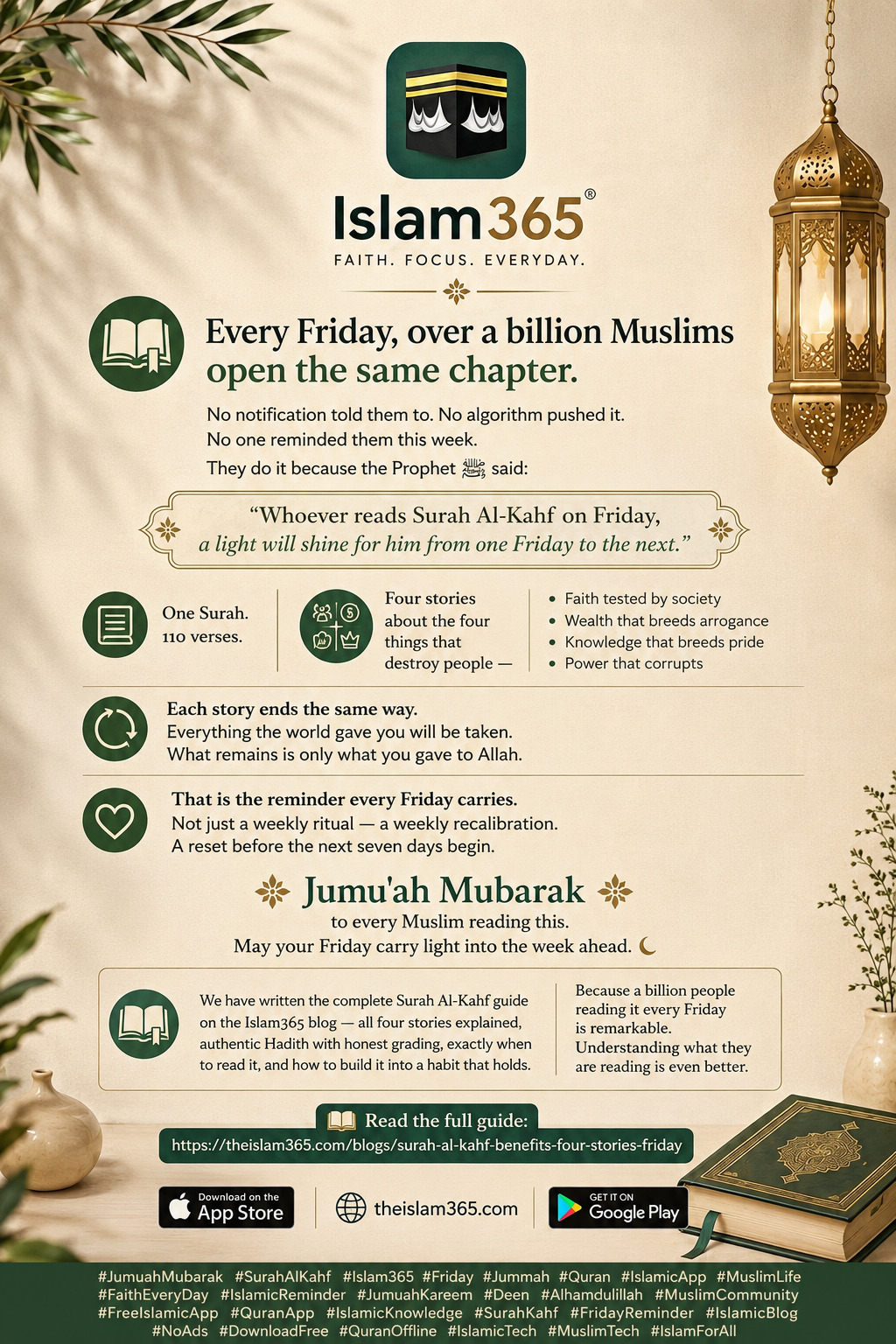
Surah Al-Kahf is the 18th chapter of the Holy Quran, containing 110 verses. The Prophet Muhammad ﷺ specifically recommended its recitation on Friday with an authenticated narration in al-Hakim and al-Bayhaqi graded Hasan by Ibn Hajar: "Whoever reads Surah Al-Kahf on the day of Jumu'ah, a light will shine for him from one Friday to the next."Memorising the first ten verses also offers protection from the Dajjal confirmed in Sahih Muslim. Read and listen to Surah Al-Kahf free in the Islam365 app App Store · Google Play.
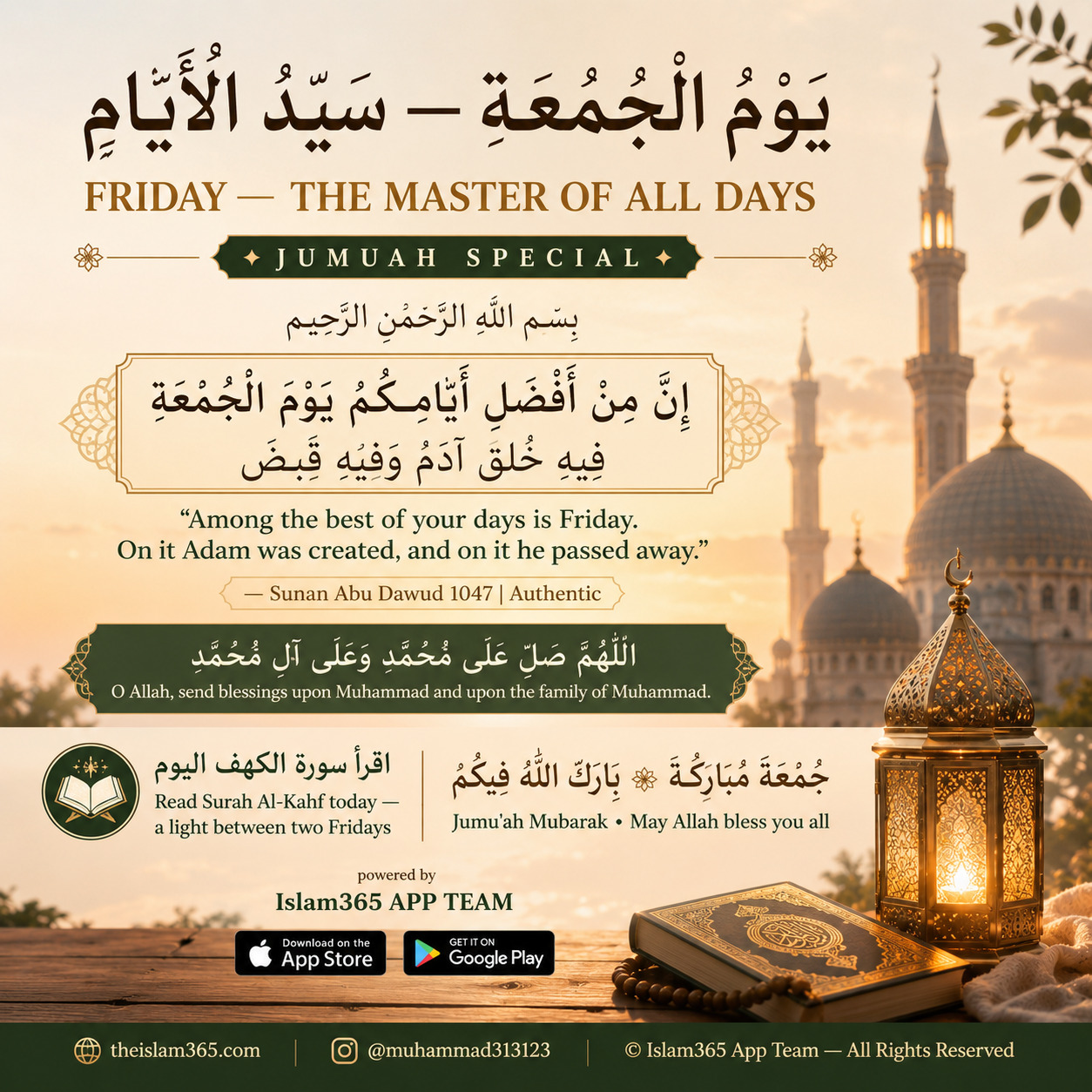
Every Friday, over a billion Muslims open the same chapter of the Quran.
Not because it was trending that week. Not because a scholar recommended it recently. Because the Prophet Muhammad ﷺ taught his Ummah over 1,400 years ago that Surah Al-Kahf on Friday carries a light a spiritual illumination that stays with the believer from one Jumu'ah to the next.
This guide gives you everything what Surah Al-Kahf is, the authenticated benefits with honest hadith grading, the four stories it contains and what each one means, when exactly to read it on Friday, how long it takes, and how to build it into a consistent weekly habit using the Islam365 app, free on iPhone and Android.
What Is Surah Al-Kahf?
Surah Al-Kahf (Arabic: سورة الكهف) means "The Cave" — named after the first of its four major stories. It is the 18th chapter of the Holy Quran, spanning Juz 15 and 16, and containing 110 verses. It is a Makki Surah revealed in Makkah before the Hijra.
Surah Al-Kahf is unique in the entire Quran for one extraordinary feature: it contains four complete, self-contained narrative stories each covering a different human trial, and each carrying a different lesson about faith, wealth, knowledge, and power. These four stories make it one of the most narratively rich and thematically comprehensive chapters in the Book of Allah.
Read Surah Al-Kahf in full Arabic text with translation in 9+ languages in the Islam365 app download free on App Store or Google Play.
Opening Verses of Surah Al-Kahf
بِسْمِ اللَّهِ الرَّحْمَٰنِ الرَّحِيمِ
الْحَمْدُ لِلَّهِ الَّذِي أَنزَلَ عَلَىٰ عَبْدِهِ الْكِتَابَ وَلَمْ يَجْعَل لَّهُ عِوَجًا
Alhamdu lillahil-ladhi anzala 'ala 'abdihi al-kitaba wa lam yaj'al lahu 'iwaja
"All praise is due to Allah who has sent down upon His Servant the Book and has not made therein any deviance."
(Quran 18:1)
قَيِّمًا لِّيُنذِرَ بَأْسًا شَدِيدًا مِّن لَّدُنْهُ وَيُبَشِّرَ الْمُؤْمِنِينَ الَّذِينَ يَعْمَلُونَ الصَّالِحَاتِ
Qayyimal liyundhira ba'san shadidan min ladunhu wa yubash-shiral-mu'mininal-ladhina ya'malunash-salihat
"[He has made it] straight, to warn of severe punishment from Him and to give good tidings to the believers who do righteous deeds."
(Quran 18:2)
Listen to Surah Al-Kahf recited by Mishari Alafasy, Abdur Rahman Sudais, and 7 other world-renowned Qaris in the Islam365 app iOS · Android.
The Authenticated Benefits of Reading Surah Al-Kahf on Friday
Benefit 1 Light from one Friday to the next
This is the most widely narrated and most well-known benefit of Surah Al-Kahf:
"Whoever reads Surat Al-Kahf on the day of Jumu'ah, a light will shine for him from one Friday to the next."
(Al-Hakim, 2/399 · Al-Bayhaqi, 3/249 graded Hasan by Ibn Hajar in Takhrij al-Adhkar, who called it "the strongest report narrated concerning Surah Al-Kahf")
A second narration from Abu Sa'id al-Khudri (RA) adds a different dimension:
"Whoever reads Surat Al-Kahf on the night of Jumu'ah will have a light that will stretch between him and the Ancient House the Ka'bah."
(Al-Darimi, 3407 graded Sahih by Shaykh Al-Albani in Sahih al-Jami', 6471)
Scholars describe this light (nur) as a spiritual illumination a clarity of heart, a guidance in decision-making, a protection from moral confusion that accompanies the believer through their entire week until the next Friday's recitation renews it. Download Islam365 free to read Surah Al-Kahf every Friday App Store · Play Store.
Benefit 2 Light from feet to sky and forgiveness of sins between the two Fridays
A third narration extends the description of the light even further:
"Whoever reads Surat Al-Kahf on the day of Jumu'ah, a light will shine for him from beneath his feet to the clouds of the sky, which will shine for him on the Day of Resurrection, and he will be forgiven his sins between the two Fridays."
(Al-Sunan al-Kubra, 5856 narrated by Ibn Umar RA)
This narration adds two extraordinary elements that the light of Surah Al-Kahf extends to the Day of Resurrection, and that regular Friday recitation carries the forgiveness of sins committed in the week between the two Fridays.
Benefit 3 Protection from the Dajjal
This is the most authenticated of all the benefits of Surah Al-Kahf, narrated in one of the most rigorously verified Hadith collections:
"Whoever memorises ten verses from the beginning of Surah Al-Kahf will be protected from the Dajjal."
(Sahih Muslim, 809 Sahih)
A separate narration in Sahih Muslim mentions "from the end of Surah Al-Kahf" and scholars have accepted both, saying either the first or last ten verses carry this protection. The reason, as Imam Al-Nawawi explained, is that the beginning of Surah Al-Kahf contains the greatest signs and miracles of Allah so one who contemplates them will not be deceived by the false wonders of the Dajjal.
Benefit 4 Sakinah (divine tranquility) descends during its recitation
"A man was reciting Surah Al-Kahf, and in the house was a horse tied with two ropes. A cloud came and began to draw nearer, and the horse began to shy away. In the morning, the man went to the Prophet ﷺ and mentioned that to him. The Prophet ﷺ said: 'That was the Sakinah which descended because of the Quran.'"
(Sahih al-Bukhari and Sahih Muslim Sahih)
This narration demonstrates the unseen spiritual reality that accompanies the recitation of Surah Al-Kahf divine tranquility descending visibly enough that even the horse could sense it.
An Honest Note on Hadith Grading
The light narration (from one Friday to the next) is graded Hasan by Ibn Hajar not Sahih as many articles claim. Hasan means a good, reliable narration with a sound chain accepted by the vast majority of Islamic scholars and fully acted upon. The protection from Dajjal narration is Sahih (in Sahih Muslim). The distinction matters for your trust in what you are reciting. The Quran deserves honesty.
The Four Stories of Surah Al-Kahf and What Each One Means
Surah Al-Kahf is structured around four complete stories, each addressing a different trial that humanity faces. Scholars have noted that these four trials faith, wealth, knowledge, and power are the exact trials the Dajjal will use against believers. This is understood as one reason why the Surah carries such specific protection against him.
Story 1: The People of the Cave The Trial of Faith
(Verses 9–26)
A group of young men in an unnamed ancient city refused to worship the idols of their people and declared their faith in Allah alone. Fearing persecution, they took refuge in a cave and Allah caused them to sleep for 309 years. When they awoke, they thought they had slept for only a day.
The lesson: when you hold onto faith in the face of a society that rejects it when you feel outnumbered, isolated, and afraid Allah does not abandon you. He may put you in a situation that looks like loss and is actually protection. The cave that looked like a hiding place was a miracle in disguise.
Story 2: The Man With Two Gardens — The Trial of Wealth
(Verses 32–44)
A wealthy man had two flourishing gardens and became arrogant, telling his believing companion: "I have more wealth than you and am mightier in men." (Quran 18:34) His companion warned him. He refused to listen. Allah destroyed both gardens. The man was left with nothing, saying: "Would that I had not associated anyone with my Lord." (Quran 18:42)
The lesson: wealth is a test, not a sign of Allah's approval. The person with more money is not the person with more worth. Everything you own can be taken in a moment. The believer says "Masha Allah, la quwwata illa billah" (Whatever Allah wills, there is no power except with Allah) the exact words the companion spoke in the story, and the words the Quran teaches us to say when we admire something we have.
Story 3: Musa (AS) and Al-Khidr The Trial of Knowledge
(Verses 60–82)
The Prophet Musa (AS) one of the greatest prophets, given the Torah and the ability to speak directly with Allah — set out on a journey to learn from a man (Al-Khidr) who had been given a special divine knowledge. Throughout the journey, Al-Khidr did things that appeared wrong to Musa: he made a hole in a boat, killed a young boy, and repaired a wall for people who had refused them hospitality. Each time, Musa objected. At the end, Al-Khidr revealed the divine wisdom behind each act the boat was saved from an unjust king, the boy's death protected his righteous parents from his future transgressions, and the wall concealed a treasure for two orphaned children whose righteous father had buried it for them.
The lesson: human knowledge is limited. What appears to be a disaster may be a mercy. What appears to be mercy may be a test. The greatest Islamic scholars, when asked about things they do not know, say: "Allah knows best." This is not a failure of knowledge it is the highest form of it.
Story 4: Dhul-Qarnayn The Trial of Power
(Verses 83–98)
A powerful and righteous king, given dominion over the earth, travels to the east and west and to a people oppressed by Gog and Magog. Rather than exploit his power for personal gain, he builds a wall of iron and copper to protect the oppressed people and attributes all of it to Allah, saying: "This is a mercy from my Lord." (Quran 18:98)
The lesson: power and authority are an amanah (trust) from Allah not a right, not a permanent possession, and not a tool for personal glory. The righteous leader serves those he leads. He remembers that the power will end, the wall will eventually collapse, and only what he did with the trust will remain.
When to Read Surah Al-Kahf on Friday
TimeRulingAfter Maghrib on Thursday eveningValid the Islamic Friday begins at Maghrib on ThursdayThursday night (after Isha)Valid and widely practisedFriday morning before Jumu'ahValid recommended by many scholars as idealDuring Friday (day)Valid — the window extends until Maghrib on FridayAfter Maghrib on FridayThe Friday window has closed counts for the following week
The complete window for reading Surah Al-Kahf for Friday's benefit runs from Maghrib on Thursday evening to Maghrib on Friday evening. Many scholars recommend Thursday night or Friday morning as the best times, so the recitation is complete before the Jumu'ah prayer.
Set a recurring weekly reminder in the Islam365 app for Thursday after Maghrib so you never miss your Friday Surah Al-Kahf download free on iPhone or Android.
How Long Does Surah Al-Kahf Take to Read?
MethodTimeSilent reading (Arabic with moderate pace)20–30 minutesListening to recitation (Mishari Alafasy)25–35 minutesReading with translation40–50 minutesJust the first 10 verses (for Dajjal protection)3–5 minutes
Surah Al-Kahf is 110 verses the longest regular weekly recitation in Islamic practice. For Muslims who find 30 minutes difficult on Friday mornings, listening to a Qari while commuting or cooking is a valid and widely practiced approach. The Islam365 app lets you listen to Surah Al-Kahf offline, with Arabic text and translation displayed as the recitation plays.
How to Make Surah Al-Kahf a Weekly Friday Habit
Set the trigger on Thursday. The most reliable approach is to set a phone reminder for Thursday after Maghrib when the Islamic Friday officially begins. Thursday night is a dedicated time with fewer distractions than Friday morning.
Start with listening. If the Arabic text feels slow to read, open the Islam365 app, go to Quran → Chapter 18 (Al-Kahf), and listen to the full recitation while following the text. Mishari Alafasy's recitation is widely considered the most accessible for following along. Download free on App Store or Google Play.
Memorise the first ten verses this month. The protection from the Dajjal (Sahih Muslim, 809) is specifically tied to memorising the first ten verses. They are approximately 10 lines of Arabic text memorisable in 2–3 weeks of daily repetition. Download offline audio of just the first ten verses and listen to them on repeat during your commute this week.
Read with translation once a month. Understanding the four stories transforms the recitation from a weekly ritual into a weekly conversation with the Quran. The Islam365 app shows Arabic and translation in your language simultaneously — English, Urdu, Pashto, French, Indonesian, Spanish, Hindi, Portuguese and more.
Frequently Asked Questions
What is the best time to read Surah Al-Kahf on Friday?
The window runs from Maghrib on Thursday to Maghrib on Friday. Most scholars recommend Thursday night (after Isha) or Friday morning before Jumu'ah as the ideal times. Set a reminder in the Islam365 app for Thursday after Maghrib so you never miss it App Store · Play Store.
Is the Surah Al-Kahf Friday hadith Sahih or Hasan?
The most widely cited narration — light from one Friday to the next — is graded Hasan by Ibn Hajar, who called it the strongest report on this topic. Hasan means a reliable, acted-upon narration accepted by the vast majority of Islamicscholars. The protection from the Dajjal narration (first ten verses) is Sahih narrated in Sahih Muslim, 809.
Can I listen to Surah Al-Kahf instead of reading it?
Yes. Attentive listening to Quran recitation is a form of worship with its own reward: "When the Quran is recited, listen to it attentively." (Quran 7:204) The Islam365 app includes Surah Al-Kahf recited by 9 top Qaris with Arabic text displayed simultaneously download free.
Do I need to read all 110 verses or just the first 10?
The full 110 verses are what the Friday narrations reference. The first ten verses specifically carry the protection from the Dajjal (Sahih Muslim). Reading the complete Surah is the full Sunnah but if time is limited, the first ten verses at minimum earn the Dajjal protection.
What are the four stories in Surah Al-Kahf?
The four stories are: the People of the Cave (trial of faith), the Man with Two Gardens (trial of wealth), Musa (AS) and Al-Khidr (trial of knowledge), and Dhul-Qarnayn (trial of power). Each story is detailed with its lesson in this article above. Read the complete Surah Al-Kahf with translation in the Islam365 app iOS · Android.
Why does Surah Al-Kahf protect from the Dajjal?
Imam Al-Nawawi explained: the beginning of Surah Al-Kahf contains the greatest signs and miracles of Allah. One who contemplates them who truly understands that Allah controls what humans cannot, that wealth and power are temporary tests, and that knowledge belongs ultimately to Allah —will not be deceived by the false wonders of the Dajjal. The Surah is spiritual training for the ultimate trial.
Conclusion
Surah Al-Kahf is not a coincidence in the Islamic weekly calendar. It is a deliberate gift 110 verses that cover the four greatest trials a human being faces (faith, wealth, knowledge, power), recited every Friday as a reset, a reminder, and a source of light that carries through the entire week.
The companions of the Prophet ﷺ understood this. Generation after generation of Muslims have understood this. And the narration remains the same: whoever reads it on Friday, a light will shine for them from one Jumu'ah to the next.
This Friday, open Surah Al-Kahf. Start with the first ten verses for Dajjal protection. Work toward the full 110. Let the four stories sit with you through the week.
Jumu'ah Mubarak. 🌙
Read Surah Al-Kahf Every Friday in Islam365 Free, Offline, Ad-Free
The Islam365 app includes the complete Quran with Surah Al-Kahf in full Arabic text, transliteration, and translation in 9+ languages. Listen to Surah Al-Kahf recited by 9 world-renowned Qaris. Download for offline access works with no signal, on planes, anywhere. Set a weekly Thursday reminder so you never miss your Friday recitation. Completely free, no ads, no signup required.