Islamic Business Ethics: 7 Principles from Authentic Hadith Every Muslim Professional Needs
Written by the Islam365 Editorial Team · 8 min read
what are Islamic business ethics?
Islamic business ethics are the moral principles governing how Muslims conduct trade, employment, and financial dealings derived from the Quran and authenticated Sunnah. The seven core principles are: honesty (Sidq), trustworthiness (Amanah), fair wages for employees, prohibition of interest (Riba), prohibition of deception, fair pricing, and social responsibility through charity. Every principle is established in authentic Hadith not theory, not modern interpretation, but direct guidance from the Prophet Muhammad ﷺ himself. Find these and related duas and Islamic knowledge in the free Islam365 app - App Store · Google Play.
The global Islamic finance market is valued at $3.96 trillion in 2026 and growing at 10% annually according to the Global Islamic Finance Report. Hundreds of millions of Muslim professionals, entrepreneurs, and business owners operate daily within or alongside an Islamic ethical framework that predates every modern employment law, corporate governance code, and business ethics textbook by more than a thousand years.
The Prophet Muhammad ﷺ was himself a merchant before prophethood. He was known throughout Makkah as Al-Amin The Trustworthy before the first revelation ever came. His business conduct became a living model for every Muslim professional who came after him.
This guide covers the seven most essential Islamic business ethics principles each one established in an authenticated Hadith, each one more precise and more demanding than its modern corporate equivalent, and each one as relevant to the boardroom of 2026 as it was to the markets of 7th-century Arabia.
Principle 1: Honesty Sidq (الصدق)
What it means: Complete truthfulness in every transaction in product descriptions, in pricing, in what you know and what you do not know about what you are selling.
The Prophet ﷺ established this standard in one of the most widely narrated business ethics Hadiths in the entire Sunnah:
الْبَيِّعَانِ بِالْخِيَارِ مَا لَمْ يَتَفَرَّقَا، فَإِنْ صَدَقَا وَبَيَّنَا بُورِكَ لَهُمَا، وَإِنْ كَذَبَا وَكَتَمَا مُحِقَتْ بَرَكَةُ بَيْعِهِمَا
Al-bayyi'ani bil-khiyari ma lam yatafarraqa, fa in sadaqa wa bayyina burika lahuma, wa in kadhaba wa katama muhiqat barakatu bay'ihima
"The two parties of a transaction have the right to cancel it as long as they have not parted. If they are honest and transparent, their transaction will be blessed. But if they lie and conceal, the blessing of their transaction will be wiped out."
(Sahih al-Bukhari 2082 · Sahih Muslim 1532 Sahih)
Modern application: Honest product descriptions, transparent pricing, disclosing known defects. In Islam, concealing a defect in what you are selling is not just a consumer protection violation it removes the divine blessing (barakah) from the entire transaction.
Principle 2: Trustworthiness Amanah (الأمانة)
What it means: Every trust placed in you financial, contractual, informational must be honoured completely.
أَدِّ الْأَمَانَةَ إِلَى مَنِ ائْتَمَنَكَ، وَلَا تَخُنْ مَنْ خَانَكَ
Addil amanata ila man a'tamanaka, wa la takhun man khanak
"Fulfil the trust to the one who entrusted you, and do not betray the one who betrayed you."
(Sunan Abi Dawud 3534 graded Sahih by Al-Albani)
The most striking element of this Hadith is the second clause even if the other party has already betrayed your trust, you are still obligated to fulfil yours. Islamic business ethics are not conditional on the other side's conduct. They are absolute.
Modern application: Honouring contracts even when it is inconvenient, protecting confidential information, fulfilling agreements to the letter regardless of what the other party has done.
Principle 3: Fair Wages and Employee Rights
What it means: Paying employees on time, in full, without delay. This is not a recommendation in Islam it is a condition of avoiding divine opposition on the Day of Judgment.
The Prophet ﷺ narrated the words of Allah directly:
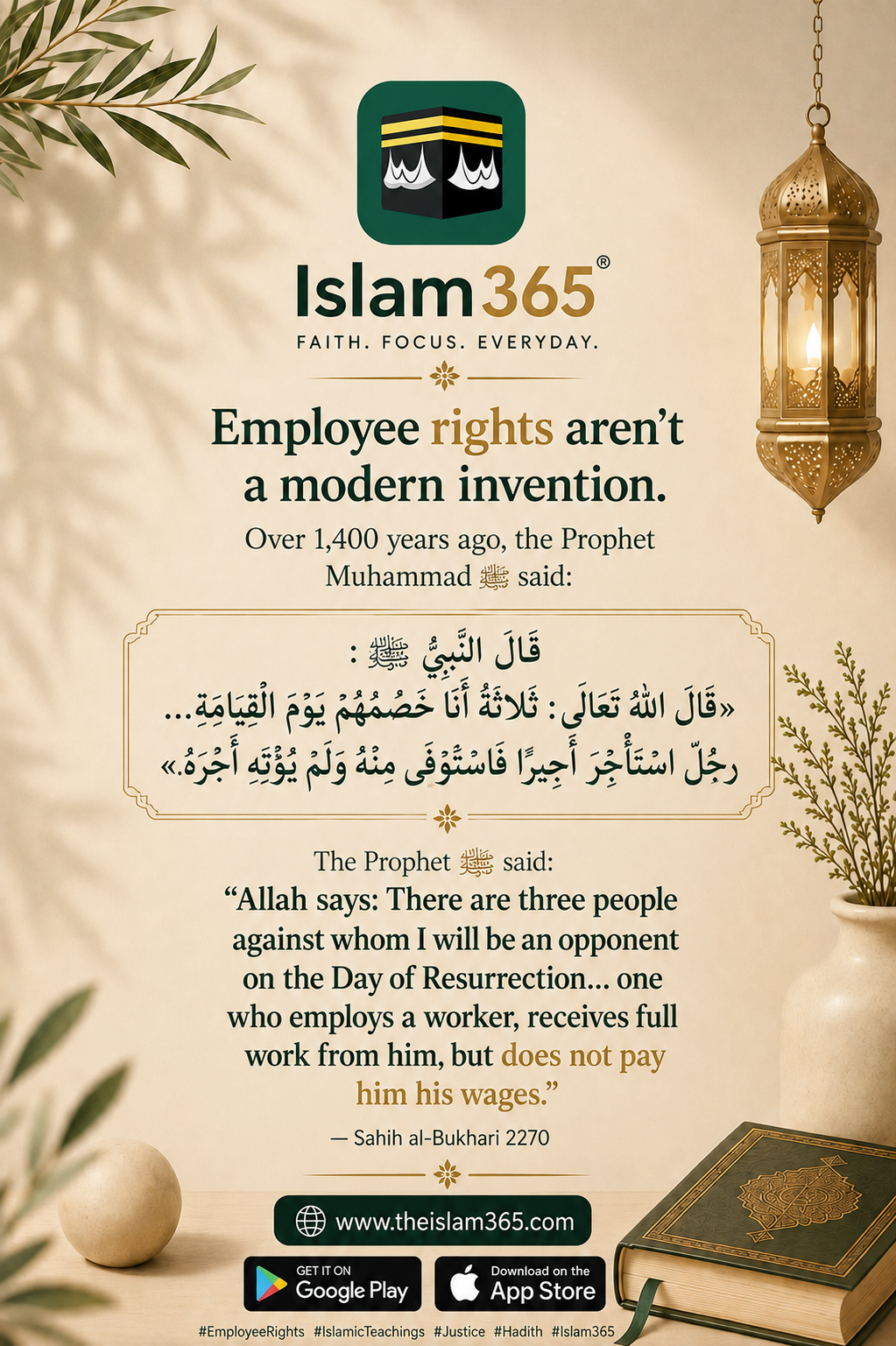
قَالَ اللَّهُ: ثَلَاثَةٌ أَنَا خَصْمُهُمْ يَوْمَ الْقِيَامَةِ... وَرَجُلٌ اسْتَأْجَرَ أَجِيرًا، فَاسْتَوْفَى مِنْهُ، وَلَمْ يُعْطِهِ أَجْرَهُ
"Allah says: There are three people against whom I will be an opponent on the Day of Resurrection... one who employs a worker, receives full work from him, but does not pay him his wages."
(Sahih al-Bukhari 2270 — Sahih)
And in a second narration establishing the timing:
"Give the worker his wages before his sweat dries."
(Sunan Ibn Majah 2443 graded Sahih by Al-Albani)
Governments wrote thousands of pages of employment law to protect workers. The Prophet ﷺ settled it in eleven Arabic words and made Allah Himself the enforcer.
Modern application: Pay employees on the agreed date without delay. Late payroll is not a cash flow inconvenience in Islamic ethics it is a grave sin with eternal consequences.
Principle 4: Prohibition of Interest Riba (الربا)
What it means: Any predetermined, guaranteed return on a loan what modern finance calls interest is prohibited in Islam without exception.
وَأَحَلَّ اللَّهُ الْبَيْعَ وَحَرَّمَ الرِّبَا
Wa ahallallahu al-bay'a wa harrama al-riba
"Allah has permitted trade and forbidden interest."
(Quran 2:275)
The Prophet ﷺ cursed the one who takes Riba, the one who pays it, the one who records it, and the two witnesses to it saying they are all equally sinful. (Sahih Muslim 1598 Sahih)
Modern application: Muslim business owners avoid conventional interest-bearing loans. Islamic finance alternatives profit-sharing (Musharakah), cost-plus financing (Murabaha), and leasing (Ijara) provide Riba-free options for business financing. The $3.96 trillion Islamic finance market exists specifically to serve this principle.
Principle 5: Prohibition of Deception Ghish (الغش)
What it means: Any form of deception, misrepresentation, or concealment of defects in a business transaction is explicitly forbidden.
مَنْ غَشَّنَا فَلَيْسَ مِنَّا
Man ghashana falaysa minna
"Whoever deceives us is not one of us."
(Sahih Muslim 102 Sahih)
This Hadith was narrated when the Prophet ﷺ passed a merchant selling food and discovered the merchant had hidden wet grain beneath dry grain to conceal its poor quality. He did not give a warning or a fine he declared that deception in trade is a disqualifying act from the Muslim community entirely.
Modern application: Accurate advertising, truthful product claims, no hidden fees, no misrepresentation in contracts or proposals. The Islamic standard is stricter than consumer protection law it covers intent, not just outcome.
Principle 6: Fair Pricing No Hoarding or Monopoly
What it means: Deliberately withholding goods to drive prices up what economists call cornering the market is sinful in Islam.
"Whoever hoards goods in order to raise their price is a sinner."
(Sahih Muslim 1605 Sahih)
The Prophet ﷺ also prohibited Najsh — artificially inflating prices by placing fake bids to deceive buyers into paying more. (Sahih al-Bukhari 2142 Sahih)
Modern application: No artificial price inflation, no monopolistic supply control, no fake bidding or false scarcity marketing. Islamic business ethics require that prices reflect genuine market conditions not manufactured demand.
Principle 7: Social Responsibility Zakat and Sadaqah
What it means: Profit in Islam is not purely personal. A defined portion of accumulated wealth belongs to those in need not as charity at the owner's discretion, but as an obligation.
"The example of those who spend their wealth in the way of Allah is like a grain of corn that grows seven ears, each bearing a hundred grains. Allah gives manifold increase to whom He pleases."
(Quran 2:261)
Zakat 2.5% of accumulated wealth above the nisab threshold is one of the Five Pillars of Islam and is obligatory on every Muslim whose wealth has been above the threshold for one lunar year. For businesses, this extends to inventory and profits.
Modern application: Muslim business owners calculate Zakat on business assets annually. Many integrate Sadaqah (voluntary charity) into business operations — setting aside a percentage of revenue as a fixed practice rather than an occasional decision.
How to Apply Islamic Business Ethics in Your Daily Work
These seven principles are not abstract theory. Here is how Muslim professionals apply them in practice:
In hiring: Choose employees for character and capability. Pay them on time, every time, without exception. Do not overwork and underpay. Do not withhold wages.
In selling: Describe your product or service exactly as it is. Disclose known defects. Never use deceptive marketing. Price fairly based on real costs and market conditions.
In contracts: Honour every agreement even when it costs you. Do not look for loopholes. Fulfil the spirit of the contract, not just its letter.
In financing: Explore Islamic finance alternatives before taking interest-bearing loans. Consult a qualified Islamic finance advisor for business financing structures.
In profit: Calculate Zakat on your business assets annually. Set aside a fixed Sadaqah percentage from revenue as a business practice, not an afterthought.
Start your workday with the morning adhkar in the Islam365 app setting the intention for an Islamic standard of conduct before the first meeting of the day. Explore the full Duas collection for supplications specific to business and livelihood. Free on iPhone and Android.
Frequently Asked Questions
What are Islamic business ethics?
Islamic business ethics are moral principles from the Quran and authenticated Sunnah governing how Muslims conduct trade, employment, and finance. The seven core principles are: honesty (Sidq), trustworthiness (Amanah), fair wages, prohibition of interest (Riba), prohibition of deception (Ghish), fair pricing, and social responsibility through Zakat. All are established in authenticated Hadith from Sahih al-Bukhari, Sahih Muslim, and other major collections.
Is interest (Riba) forbidden in all Islamic business transactions?
Yes. Riba any predetermined guaranteed return on a loan is explicitly prohibited in Quran 2:275 and confirmed by multiple narrations in Sahih Muslim 1598. The $3.96 trillion global Islamic finance industry exists specifically to provide Riba-free alternatives including Musharakah (profit-sharing), Murabaha (cost-plus financing), and Ijara (leasing). Download Islam365 to access duas for halal provision and livelihood.
What does Islam say about paying employees late?
The Prophet ﷺ narrated that Allah says He will personally oppose on the Day of Judgment anyone who employs a worker, receives full work, but does not pay wages. (Sahih al-Bukhari 2270) A separate Hadith instructs paying wages before the worker's sweat dries. (Ibn Majah 2443, Sahih) Late payment of wages is considered a grave sin in Islam.
What is Amanah in Islamic business?
Amanah (trustworthiness) means honouring every trust placed in you financial, contractual, or informational regardless of whether the other party honours theirs. The Prophet ﷺ said: "Fulfil the trust to the one who entrusted you, and do not betray even the one who betrayed you." (Abu Dawud 3534, Sahih) In business, Amanah covers contracts, client confidentiality, financial stewardship, and honest reporting.
Is hoarding goods to raise prices allowed in Islam?
No. The Prophet ﷺ explicitly said: "Whoever hoards goods in order to raise their price is a sinner." (Sahih Muslim 1605) Deliberately restricting supply to manipulate prices is a sin in Islamic business ethics not merely an ethical concern but a religious prohibition.
How do Islamic business ethics compare to modern corporate ethics?
Islamic business ethics are older, more specific, and carry consequences no corporate governance code can including divine accountability. Where modern ethics are aspirational guidelines, Islamic principles are religious obligations backed by authentic Hadith. The Prophet ﷺ established worker protections, consumer rights, and anti-monopoly principles 1,400 years before employment law, consumer protection acts, or antitrust regulation existed.
Can a Muslim work in conventional banking?
This is a matter of scholarly difference. Many scholars advise against working directly in Riba-based banking. Others permit general roles not directly involved in interest transactions. The unanimous position is that directly facilitating Riba recording, witnessing, or executing interest contracts is prohibited based on Sahih Muslim 1598. Individual cases should be discussed with a qualified Islamic scholar.
Conclusion
Islamic business ethics are not a medieval framework struggling to apply to a modern economy. They are a precisely calibrated moral system that addressed honesty in advertising, employee wage protection, anti-monopoly principles, and social wealth redistribution before any government in history had put them into law.
The seven principles in this guide — honesty, trustworthiness, fair wages, no interest, no deception, fair pricing, and social responsibility are not seven suggestions. They are seven obligations, each established in authenticated Hadith, each carrying accountability not to a regulator or a court, but to Allah.
For the Muslim professional, they are not a constraint on business success. They are the foundation of business that lasts with barakah (blessing) built into every transaction conducted within them.
Related reading on the Islam365 blog:
- Rights of Employees in Islam the two Hadiths on wages in full detail
- Dua for Anxiety and Stress for the difficult days in business
- Ayatul Kursi to recite before every important meeting
Download #Islam365 Free Islamic App for Muslim Professionals
Islam365 includes daily duas for livelihood and provision, morning and evening adhkar, the complete Quran with 9 Qaris, prayer times with GPS accuracy, and the full Islamic knowledge hub all free, ad-free, no signup required. Built for the Muslim who wants their Deen and their professional life working together.