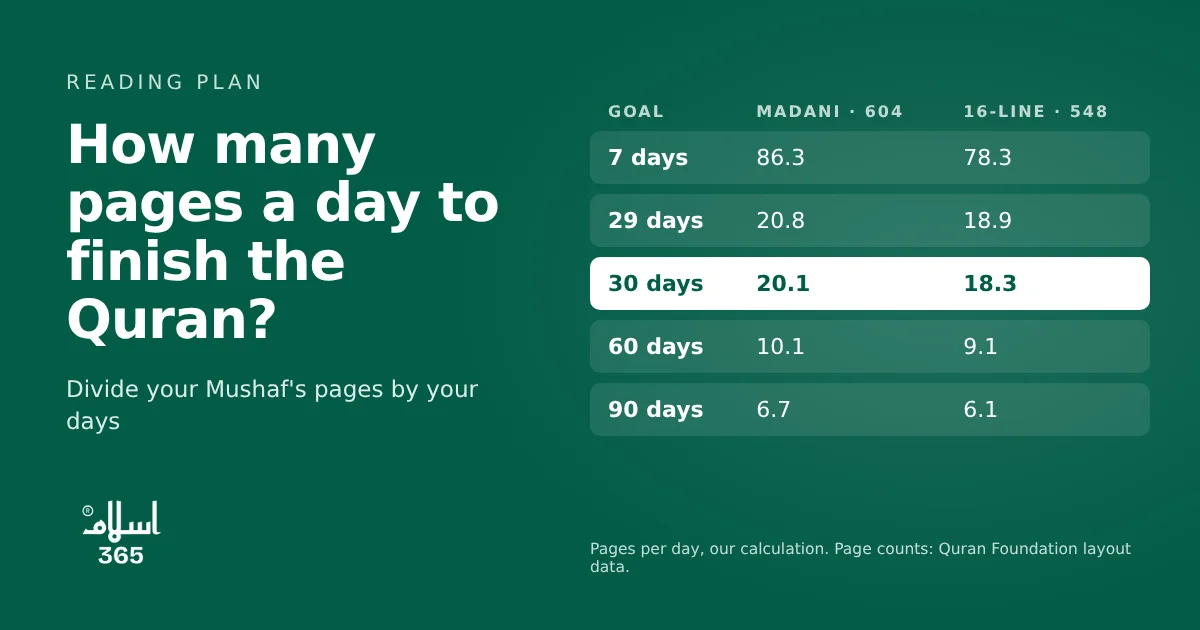
Short answer: to finish the Quran in 30 days, read about 20 pages a day in the 604-page Madani Mushaf, or about 18 pages a day in the 548-page 16-line IndoPak Mushaf. Spread over the five daily prayers, that is roughly four pages after each prayer. The exact figure depends on which printed layout you read and how many days you have, so the tables below work it out for the most common goals. Every number in them is our own division of the page counts, which you can check with a calculator.
First, how many pages does your Mushaf have?
The Quran is the same text in every copy, but printed copies lay it out differently, so the page count is a property of the edition, not of the Quran. This guide uses two common layouts:
- The Madani Mushaf, 604 pages. The standard edition printed by the King Fahd Complex in Madinah uses a 604-page format, following the Hafs an Asim recitation (Wikipedia: Uthman Taha Quran).
- The 16-line IndoPak Mushaf, 548 pages. The layout in IndoPak script with 16 lines on each page. The Quran Foundation's layout data lists "IndoPak with 16 lines per page" at 548 pages, and a 15-line IndoPak layout at 610 pages (Islam365 Foundation: Page Layout guide).
Before you plan, look at the last page number of your own copy. Printers vary, and a copy with commentary or translation alongside the Arabic can have many more pages. The method below works for any number: divide the pages by the days.
Pages per day for common goals
Our calculation, rounded to one decimal place:
GoalMadani (604 pages)16-line IndoPak (548 pages)7 days 86.3 pages a day, 78.3 pages a day, 10 days 60.454.829 days20.818.930 days20.118.360 days10.19.190 days6.76.1365 days1.71.5 The 29-day row is there for a reason. Islamic months have either 29 or 30 days, and Britannica notes they are "alternately 30 and 29 days long" in the calculated calendar (Islam365: Islamic calendar). Start dates are often announced only after the crescent moon has been looked for; when the UAE announced the start of 1448 AH, for example, its Fatwa Council did so after reviewing crescent-sighting data (Khaleej Times). So you will not know far in advance whether Ramadan has 29 days or 30. If you want to finish within the month either way, plan for 29.
Dividing it across the five prayers
Twenty pages in one sitting is a lot for most people. Linking the reading to the five daily prayers breaks it into pieces that fit around work and family.
GoalMadani: pages after each prayer16-line IndoPak: pages after each prayer30 daysabout 4 (4.03)about 3.760 daysabout 2about 1.8 A worked example for the Madani Mushaf: four pages after each of the five prayers is 20 pages a day. Over 30 days that is 600 pages, which leaves 4 pages (604 minus 600) to add on one of the days. You might make up the difference on a weekend or on the last day.
For a 29-day month, 21 pages a day reaches 609, so you finish with a little room to spare. Five pages after Fajr and four after each of the other prayers gives exactly 21.
Using juz instead of pages
The Quran is also divided into 30 parts, each called a juz' (para in Urdu), and each juz' is split into two hizb, 60 in all. Wikipedia notes that the parts are "of varying lengths" and that "some use these divisions to facilitate recitation of the Qurʼān in a month" (Islam365: Juz').
So "one juz' a day" finishes the Quran in 30 days; Wikipedia gives the Tarawih prayers of Ramadan as an example of the divisions being used this way. In the 604-page Madani layout, 604 divided by 30 is about 20 pages, so a juz' there averages about 20 pages. Because the parts vary, some days will be a page or two longer than others. Pages are easier to split across prayers, and juz are easier to track with a printed set of 30 booklets. Pick whichever you will actually keep.